5 Types of Workplace Drug Tests Employers Can Use
5 Types of Workplace Drug Tests Employers Can Use
Workplace drug testing can help employers maintain a safer, more productive, and compliant work environment. However, not every drug test is the same. Different testing methods have different detection windows, collection procedures, and applications.
For employers developing or updating a workplace drug testing program, understanding the available testing methods is an important first step.
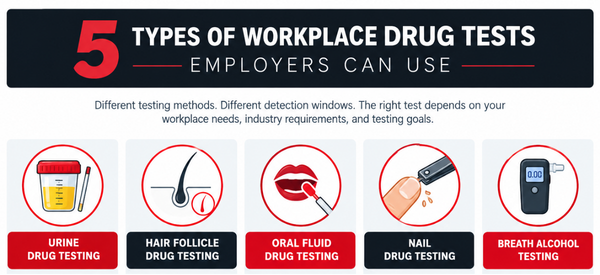
Here are five common types of workplace drug tests employers can use.
1. Urine Drug Testing
Urine testing is one of the most widely used methods for workplace drug screening.
A urine specimen is collected and analyzed for specific drugs or their metabolites. Depending on the testing panel and substance, urine testing can detect recent drug use over a period ranging from several hours to several days or longer.
Urine testing may be used for:
- Pre-employment testing
- Random drug testing
- Post-accident testing
- Reasonable suspicion testing
- Return-to-duty testing
- Follow-up testing
- DOT and non-DOT testing
For employers looking for a widely established testing method, urine testing is a common option.
2. Hair Follicle Drug Testing
Hair testing uses a small sample of hair to identify evidence of drug use over a longer detection period than many urine tests.
Hair testing can provide a longer historical window and may be useful when an employer wants to identify patterns of drug use rather than only very recent use.
Common applications include:
- Pre-employment screening
- Workplace drug testing programs
- Comprehensive employee screening
- Situations where a longer detection window is desired
Hair testing does not generally identify very recent drug use as effectively as some other testing methods, so employers should select the testing method based on the purpose of the test.
3. Oral Fluid Drug Testing
Oral fluid testing, sometimes called saliva testing, collects a specimen from inside the donor’s mouth.
One advantage of oral fluid testing is that collection can be convenient and can generally be performed under direct observation, depending on the testing procedure and applicable requirements.
Employers may use oral fluid testing for:
- Workplace screening
- Post-accident testing
- Reasonable suspicion testing
- Random testing
- Rapid testing programs
Because oral fluid testing generally focuses on more recent drug exposure, it can be useful when recent use is the primary concern.
4. Nail Drug Testing
Nail testing uses clippings from fingernails or toenails for drug analysis.
Like hair testing, nail testing can provide a longer detection window than urine or oral fluid testing. This makes it another option for employers seeking information about drug exposure over an extended period.
Nail testing may be considered when:
- A longer detection window is important
- Hair collection is not practical
- An employer wants an alternative specimen type
- A comprehensive screening program is being considered
The appropriate testing method depends on the employer’s goals, applicable regulations, and the circumstances of the test.
5. Breath Alcohol Testing
Breath alcohol testing is different from drug testing because it measures alcohol in a person’s breath rather than testing a specimen for drug metabolites.
Employers may use breath alcohol testing as part of workplace alcohol policies or safety-sensitive testing programs. It can provide an indication of alcohol concentration at or around the time of testing.
Breath alcohol testing may be used in circumstances such as:
- DOT testing
- Post-accident testing
- Reasonable suspicion testing
- Workplace alcohol programs
- Safety-sensitive positions
Employers should follow applicable federal, state, and industry requirements when establishing alcohol testing procedures.
Which Workplace Drug Test Is Right for Your Business?
There is no single testing method that is appropriate for every workplace.
The right option depends on several factors, including:
- The reason for testing
- Desired detection window
- Industry requirements
- DOT or non-DOT status
- Company drug and alcohol policy
- State and federal requirements
- Type of workforce
- Testing frequency
For example, an employer conducting pre-employment screening may select a different testing method than an employer responding to a workplace accident or conducting a DOT-regulated test.
DOT vs. Non-DOT Testing
Employers should also understand whether their testing program is subject to Department of Transportation (DOT) regulations.
DOT-regulated employers and employees must follow specific federal testing requirements, including requirements concerning testing procedures, specimen collection, laboratories, and documentation.
Non-DOT employers generally have more flexibility in designing their testing programs, but they must still comply with applicable federal, state, and local laws as well as their own written policies.
Build a Workplace Testing Program With NTS
Choosing a testing method is only one part of an effective workplace drug and alcohol testing program.
We provide workplace testing solutions for employers
Including drug and alcohol testing options designed for different workplace needs.
Whether you need pre-employment, random, post-accident, reasonable suspicion, DOT, or non-DOT testing, NTS can help you identify an appropriate testing solution for your organization.
A well-structured testing program can help employers establish consistent procedures and support a safer workplace. Need workplace drug testing for your organization? Contact National Testing Services to discuss your testing needs.
Frequently Asked Questions
What is the most common workplace drug test?
Urine drug testing is one of the most commonly used workplace drug testing methods. However, the appropriate testing method depends on the employer's needs, applicable regulations, and the purpose of the test.
How long can drugs be detected in a workplace drug test?
The detection period varies depending on the substance, testing method, frequency of use, and other factors. Urine, oral fluid, hair, and nail testing can each provide different detection windows.
Are hair tests better than urine tests?
Neither method is universally better. Hair testing can provide a longer detection window, while urine testing is commonly used for detecting more recent drug exposure. Employers should choose a method based on the purpose of testing and applicable requirements.
Can employers use saliva drug testing?
Yes. Oral fluid testing can be used for workplace drug testing when permitted under the applicable testing program and regulations.
Does DOT testing have different requirements?
Yes. DOT-regulated testing programs must follow specific federal requirements. Employers should ensure their testing procedures comply with the regulations applicable to their industry and workforce.
Can NTS provide mobile workplace drug testing?
National Testing Services provides mobile testing solutions that can allow testing to be performed at a workplace or other designated location, depending on the service and location.
Drug Testing Compliance Guide for Employers
Download our latest employer guide and stay informed on testing requirements and best practices.